The case against the rented handset.
The rented handset solved a real problem in 1995. The constraints that made it the right answer are gone. What's left is a piece of hardware that creates three new problems and solves none of the original ones — and museums keep renewing the contract anyway.
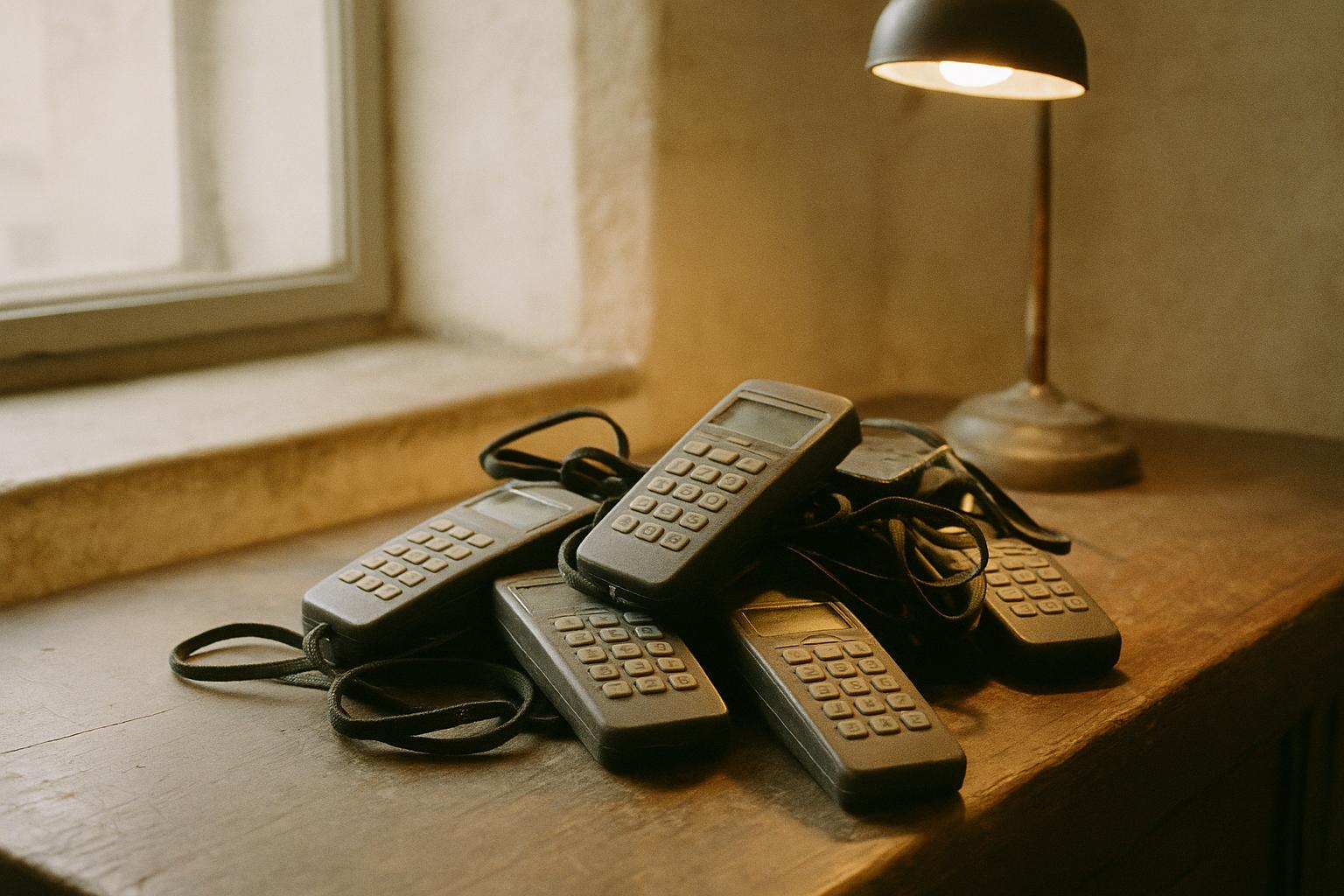
I want to argue something that, depending on where you sit, is either obvious or heretical: the rented handset audio guide — the lanyard-and-keypad thing visitors check out at the desk — has stopped solving a problem worth the cost of carrying it. It made sense for thirty years. It does not make sense now. The contracts museums keep renewing on it are renewing a 1995 answer to a 1995 question that no longer applies in 2026.
Let me make the argument carefully, because I'm aware it sounds like a vendor's argument, and I'm a vendor. But the math here isn't a function of who's making the case. It's a function of what visitors carry, what museums can afford to clean, and what the operating budget actually has to absorb in a year.
The 1990s argument, fairly stated
I want to start by giving the rented handset the credit it deserves, because the people who designed the original audio-guide hardware were not stupid. They were responding to real constraints.
In 1995, museum visitors did not all carry capable computers in their pockets. The first iPhone shipped twelve years later. The 1995 visitor showed up with cash, a paper map, and at most a Walkman, and the museum could not assume any device in particular. So if you wanted to deliver audio interpretation, you had to provide the device. There was no choice.
In 1995, network coverage inside a stone-walled museum was unreliable in a way the public Wi-Fi era hasn't quite eliminated but has dramatically improved. The handset solved this by preloading content. The audio was on the device when the visitor picked it up. The museum did not have to worry about whether the visitor could reach a server.
And in 1995, museums had to maintain a kind of editorial control over the visitor's experience that we have largely forgotten about now. The handset was a curated object. The institution chose what was on it, how the menu worked, what the tour included. That control mattered when there was no other way to ensure the visitor encountered the curatorial program.
All three of these were real. Each one made the handset the right answer for its time. If you were running a museum in 1995 and you skipped the handset, you were skipping audio interpretation entirely, which was worse.
But the world stopped being 1995 some time ago, and the three constraints that made the handset the right answer have all collapsed.
What changed, in three numbers
Three numbers tell the entire story.
Smartphone ownership in the United States is now around 91% across all adults, and well above 95% in the demographic profile that walks into a museum on a Saturday — adults 30 to 49, urban, college-educated, household income above the median. That is functional saturation. The 1995 assumption — that the museum has to provide the device because the visitor isn't carrying one — became wrong somewhere around 2015 and is now indefensible. The visitor walked into the building with a device that has a better screen, a better speaker, a faster processor, and a more capable operating system than the handset the museum is about to rent them.
Public Wi-Fi inside museum buildings is, for most institutions, no longer the constraint it was. Adding network coverage to a lobby is a quarter of a build-out cost relative to running a fleet of charging racks, and the audio doesn't need to stream — it can preload on first scan, exactly the way a handset preloaded in the early-2000s era. The 1995 connectivity argument has structurally inverted: the visitor's phone has more reliable connectivity in 2026 than the museum's loaner hardware does.
And the third number — the one that often gets left out — is the post-2020 hygiene shift. Visitors became measurably more reluctant to handle shared electronics, and the reluctance did not reset when the pandemic stopped being the lead story. Museums I've talked with reported handset checkout rates falling 30 to 50 percent from 2019 baselines and never fully recovering, even as overall attendance came back. The handset stopped being a convenience and started being a friction asset, in a way it had never been before, and the change appears to be permanent.
Each of these is, on its own, a problem the original 1995 argument doesn't have an answer for. Together they aren't a problem at all. They are the case for retiring the model.
The three problems the handset now creates
The handset, in 2026, is not a neutral choice. It is an active source of operating cost that the museum could be spending on interpretation instead.
The first cost is sanitation labor. Two minutes of staff time per use, applied to a busy fleet, adds up to the equivalent of roughly a quarter of a full-time equivalent on cleaning alone. This wasn't a line item in 2019. It is one now, and no visitor-services director I've talked to since 2020 has been willing to defend cutting it. The cleaning isn't going back down. It is, structurally, a cost that the handset has acquired and won't shake.
The second cost is the operating envelope around the device itself. Batteries and chargers. Breakage and replacement. The five-year refresh cycle on the fleet. The chargers and racks. The cumulative annual operating cost of a mid-size handset fleet, after you account for everything that gets used up or breaks, lands somewhere in the low five figures per year before any of the content costs you separately. This isn't speculative — the math is published by the vendors themselves if you push hard enough on the invoice. It just doesn't appear in the RFP because the RFP was structured to make the hardware look like a one-time capital expense.
The third cost is the queue. The 90-second exchange at the audio guide desk — ID, deposit, lanyard, brief instructions, the visitor learning the menu, the visitor returning the unit at the end — is invisible operating overhead when the fleet is humming and acute when it isn't. It eats opening-hour throughput. It creates a staffing shape the museum has to maintain. And it is, from the visitor's perspective, the first interaction with the museum that demands paperwork, which is not the interaction most curators would have chosen.
Add the three and the handset costs a museum, in operating terms, more than the audio interpretation it's delivering. That's not a math result anyone designed for. It's a math result that fell out of the world changing under a model that was built for a different one.
What the data shows about visitors
The other piece of the argument is one I think the museum field already knows but hasn't fully internalized.
Visitors under 40 have a preference for using their own phones that approaches universal. They scan a QR code without thinking about it. They will not download a museum-specific app for one visit, but they will tap a notification that opens a web player in their browser. They expect this to be the default. When it isn't — when the museum's audio tour requires picking up a piece of hardware they didn't bring — they don't pick up the hardware. They skip the audio entirely.
That decision doesn't show up cleanly in the rented-handset checkout rate, because the people who skip don't appear in the data. They walk through the gallery without audio. The museum tells itself this is fine because the wall text is doing the work. The data on what visitors actually retain from wall text alone — there's a body of museum-studies research on this and it's not flattering — suggests this is the optimistic reading.
The handset model is, increasingly, an interpretation program that the museum is paying to make less useful than it could be.
Where the rented handset still wins
This is the honest section, and I want to make it as carefully as the rest of the argument.
There are four cases — and only four — where the rented handset is the right answer in 2026.
The first is the named-voice production. If the audio tour features a specific human reader — a curator, a donor with an institutional connection, a celebrity ambassador whose involvement is itself part of the curatorial offer — and the institution wants the front-desk interaction to be part of the experience, the handset can carry that. A handset is a museum artifact that gets checked out, and for a flagship named-voice tour with a high production budget, the lanyard ritual fits. This is what the Met audio guide is, in a structural sense, and the Met audio guide is good. Phone-based delivery wouldn't ruin it; it just wouldn't add anything.
The second is dedicated accessibility hardware. Some visitors benefit from a device with a tactile keypad, larger buttons than a touchscreen, a wired wand for hearing-loop coupling, or a specific accommodation that smartphones don't provide for them. A small dedicated accessibility fleet, sized to the actual accommodation demand, is the right answer here even if everyone else is on BYOD. This is a real case and worth respecting.
The third is the no-signal gallery. A growing share of phone-based platforms support preloaded offline playback after a first load at the entrance, which solves connectivity for most institutions. But if your building has a deep no-signal pocket — basement of a stone fortress, deep gallery in a former industrial site, the inside of a tomb — and you cannot get visitors onto a network anywhere on the property, rented hardware preloaded with content remains the cleaner answer. This is a smaller and smaller set of museums each year, but it isn't zero.
The fourth is the mid-contract reality. If you signed a multi-year handset-and-content contract with a legacy vendor three years ago and you've got two more years on the deal, the right move isn't to break the contract. The right move is to ride it out, capture analytics on what's working, and plan the BYOD migration for the renewal boundary. The economics rarely pencil for an early exit.
If none of those four describe your situation, the case for the rented handset, in 2026, is a case for renewing 1995's answer to 1995's question and absorbing the cost of that decision in your operating budget.
The recommendation, more carefully than "ban the handset"
I am not arguing that museums should rip out their handset fleets next month. That's not how this works.
I am arguing that the handset, as a default for audio interpretation, has aged out of the operating math. When the current contract comes up for renewal, the conversation a director should have isn't "do we renew this?" — it's "what would BYOD as the primary delivery, with a small loaner fleet at the desk for the visitors who actually need one, cost us?" In every case I've walked through, the answer is "much less than the renewal." Not because BYOD is free, but because the operating cost of the handset has been quietly compounding in the background since 2020, and the renewal is the moment that compounding shows up on the invoice.
The visitor preference flipped. The operating math flipped. The handset is a 1995 answer waiting to be retired. The question for any institution still on a fleet contract isn't whether to retire it. It's when.
About the author
Eric Duffy is the founder of Convo, a platform that helps museums and cultural institutions publish multilingual audio tours their visitors can have a conversation with. He writes about the operating economics of museum interpretation from inside the category. Reach him at eric@convo.app or on LinkedIn.