Families, scholars, and first-timers: one collection, many audiences.
A retired art historian and a seven-year-old stand three feet apart in front of the same painting. They want completely different things. The museum has one audio tour. Who is it for?
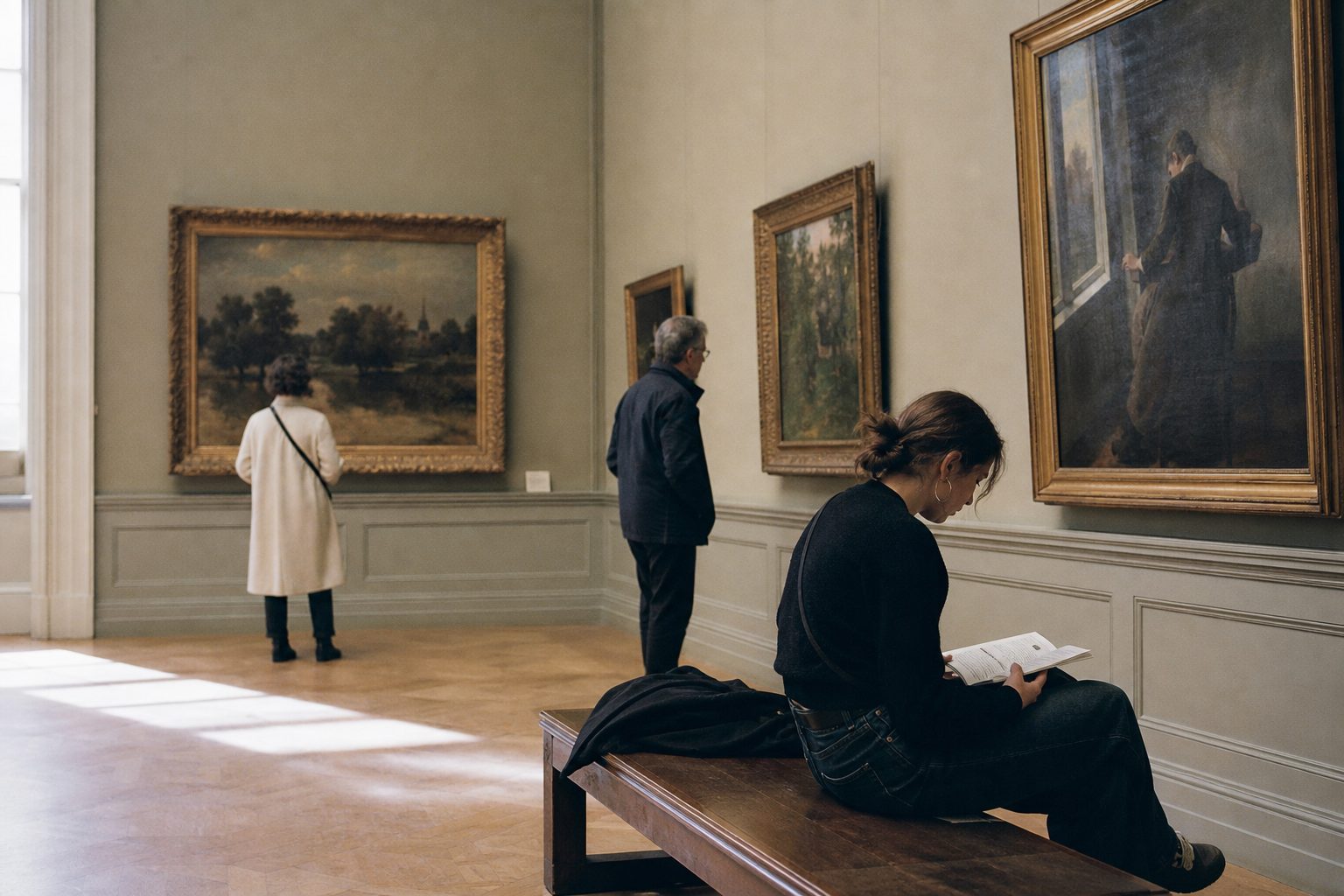
A retired art history professor stands in front of Monet's water lilies. She's seen reproductions hundreds of times, taught this period for decades, written papers on Impressionism. She wants to know: how does this particular painting relate to the Giverny series? What was Monet's eyesight like when he painted it? How does the museum's conservation approach compare to the Musée de l'Orangerie's?
Three feet away, a seven-year-old tugs at his mother's hand. He wants to know: why are the colors so blobby? Did the painter do that on purpose? Can we go see the dinosaurs now?
Same painting. Same moment. Completely different needs.
The museum has one audio tour. It was written for — whom, exactly?
The impossible compromise
Every museum knows its audience is diverse. Families with young children. School groups on field trips. Tourists with two hours to see the highlights. Members who visit monthly and want fresh perspectives. Scholars conducting research. First-time visitors who don't know Monet from Manet.
Traditional audio tours try to serve everyone with the same content. The result is predictable: a compromise that fully satisfies no one.
- Too basic for experts. The professor doesn't need to be told that Monet was a French Impressionist. But the tour spends thirty seconds on context she learned decades ago.
- Too advanced for newcomers. The first-time visitor hears references to "the Impressionist movement" and "plein air painting" without enough context to understand why these matter.
- Too long for families. The seven-year-old lost interest ninety seconds in. His parents are now managing a bored child instead of looking at the art.
- Too short for the curious. The visitor who wants to go deeper hits the end of the stop and wishes there was more.
The traditional solution? Create multiple tours. A family tour. A highlights tour. A scholarly deep-dive. An introductory tour for first-timers.
But multiple tours mean multiple production budgets. At the scale legacy vendors quote — see the math in how long an audio tour actually takes to produce — most museums can barely afford one. The dream of serving diverse audiences with tailored content remains exactly that. A dream.
What different visitors actually need
Let's be specific about what different visitors want when they stand in front of the same painting.
The first-time visitor
- Orientation: what am I looking at? Why is it here?
- Permission: is it okay that I don't immediately "get it"?
- Entry points: what should I notice? Where do I start?
- Context: why does this matter? Why should I care?
The family with young children
- Engagement hooks: what will capture a child's attention?
- Manageable depth: information in small, digestible pieces
- Interactive elements: questions to discuss, things to look for
- Flexibility: easy to pause, skip, or move on when attention wanes
The tourist
- Efficiency: what are the must-sees? How should I prioritize?
- Highlights: what makes this collection special?
- Photo context: what's the story behind what I'm photographing?
- Cultural significance: why do people travel to see this?
The repeat visitor or member
- Fresh perspectives: what's new? What haven't I noticed before?
- Deeper layers: beyond the basics I already know
- Connections: how does this relate to other works, other artists, other periods?
- Behind-the-scenes: conservation stories, acquisition history, curatorial choices
The scholar or expert
- Technical detail: technique, materials, condition
- Historiography: how has interpretation of this work evolved?
- Provenance: ownership history, exhibition history
- Comparative context: how does this relate to the artist's other work, to contemporaries?
One script cannot serve all these needs. The information density that satisfies the scholar overwhelms the first-timer. The engagement hooks that capture children bore the expert. The efficiency the tourist needs frustrates the member who wants depth.
The segmentation trap
Some museums try to solve this with visitor segmentation — creating different content for different audience types.
The theory is sound. The practice is brutal.
- Production multiplication. Every segment means another production budget. Family tour, scholar tour, highlights tour — suddenly you're looking at three full cycles just to serve three audience types.
- Maintenance multiplication. When the collection changes, you're updating three tours instead of one. When research evolves, three scripts need revision. The staleness tax multiplies with each additional tour.
- Choice paralysis. Present visitors with four tour options and watch them freeze. Which one am I? What if I pick wrong? Some visitors give up and take no tour at all.
- Imperfect fit. Even with multiple tours, visitors don't fit neatly into categories. The scholar who's also a parent. The first-timer who happens to have deep knowledge of one particular artist. The tourist who unexpectedly falls in love with a work and wants to go deeper.
Segmentation helps, but it doesn't solve the fundamental problem. Pre-recorded content is static, and visitors are dynamic.
The question changes everything
Here's what shifts the equation: what if visitors could ask their own questions?
Not choose from a menu of pre-recorded options. Not select "family mode" or "expert mode" at the start. But actually ask whatever they're curious about and get a relevant response.
The seven-year-old asks: "why does it look all blobby?"
The response explains how Monet painted with visible brushstrokes to capture light and movement, how standing far away makes the blobs become water and flowers, how this was a new way of painting that people thought was weird at first.
The professor asks: "how does this relate to the late Giverny series?"
The response discusses Monet's declining eyesight, the shift in palette and scale in his final works, how this particular painting fits in the chronology, what conservation analysis has revealed about his technique during this period.
Same painting. Same source. Different questions. Different responses.
This is what a conversational tour makes possible: interpretation that adapts to who's asking, instead of forcing everyone through the same script. Recent peer-reviewed work — including the 2025 ACM IMX study of a generative-AI chatbot in an art museum — describes the engagement difference in measurable terms.
Depth on demand
The key insight is that visitors self-select their depth through their questions.
A visitor who asks "what is this?" needs different information than one who asks "how does this compare to the artist's earlier work?" The question itself reveals what level of context the visitor has and what they're ready to learn.
Traditional audio tours guess at the right depth and lock it in. They aim for the middle and miss everyone.
A conversational approach lets visitors drive their own depth:
- Start shallow, go deep. A visitor can begin with basic orientation and then ask follow-up questions to go deeper. "Tell me more about that." "What do you mean by Impressionism?" "How did he create that effect?"
- Start deep, stay deep. The expert can skip the basics entirely and engage at the level they're ready for. No wading through context they already have.
- Change direction. A family can start with the child's question, then shift to the parent's interest, then move on when attention fades. The session adapts to the moment.
- Satisfy curiosity. When something sparks interest, visitors can pursue it. When it doesn't, they can move on. No one is trapped in content that doesn't serve them.
What this means for museums
The dream of serving diverse audiences with tailored content has always been limited by production economics. You couldn't afford to create separate experiences for every visitor type, so you created one experience and hoped for the best.
That constraint is lifting.
When the same curatorial corpus can answer different questions with different responses — adapting to who's asking — the segmentation problem dissolves. You don't need separate tours for families and scholars. You need a system that responds appropriately to both.
This doesn't eliminate the need for thoughtful interpretation. The curatorial expertise that shapes what the corpus contains, the institutional voice that guides how it responds, the scholarly accuracy that ensures it's trustworthy — these remain essential. What changes is the delivery mechanism.
Instead of one script broadcast to everyone, you have a knowledgeable presence that meets each visitor where they are. Grounded answers are visitor-facing responses sourced from a defined curatorial corpus rather than general model knowledge — when the source doesn't cover a question, the guide says so.
The inclusive promise
There's a deeper principle here about what museums are for.
Mission statements talk about serving "all visitors" and "diverse communities." But when interpretation is one-size-fits-all, some visitors are inevitably underserved. The child who can't engage with adult-oriented content. The expert who's bored by introductory material. The non-English speaker who gets the brochure instead of the full content.
Truly inclusive interpretation means meeting visitors where they are — not where the median visitor is assumed to be.
The retired professor and the seven-year-old both deserve to have their curiosity met. They both deserve to leave having learned something, having connected with the work, having had their questions answered.
When interpretation can adapt to who's asking, that inclusive promise becomes achievable. Not as an expensive option requiring multiple production budgets, but as a standard capability available to any museum that wants it.
The family, the scholar, and the first-timer can all stand in front of the same painting and each have the conversation they need. That's not a compromise. That's the goal.
This connects to broader questions about access — including language access — and to the shifting expectations visitors bring from their everyday interactions with the assistants in their pockets.
About the author
Eric Duffy is the founder of Convo, a platform that lets museums and cultural institutions publish multilingual audio tours their visitors can have a conversation with. He writes about how museums could afford to be more ambitious with interpretation, drawing on discovery conversations with curators, directors, and education leads at small and mid-size US museums. Reach him at eric@convo.app or on LinkedIn.